The international road project between Cairo and Cape Town will be built on a length of 170km with a cost of $140m
(Photo courtesy of Africa geographic website )
The Arab Contractors Co. is building two projects in Ethiopia, with investments amounting to more than $111m, according to the company President and CEO Mohsen Salah.
In a press statement Saturday, Salah said the company built construction projects in Ethiopia last year with investments amounting to $30m, and Ethiopian employment in the two projects is approximately 90%.
“The company is studying building a new affordable housing project in Addis Ababa, such as residential buildings of 7, 9, and 12 floors”, added Salah. “The company is willing to participate in carrying out Ethiopian development projects, which the government intends to put forward during the current stage.”
The two roads are represented in two phases of the international road between Nairobi in Kenya and Addis Ababa the Ethiopian capital. The international road is considered a part of international road project between Cairo and Cape Town in South Africa.
Head of the East and West Africa sector Ibrahim Mabrouk said that the first road is on a length of 94.5 km, and the rate of completion reached 88% with a cost of $ 54.7m. It is expected to be completed by the end of May 2015.
Managing Director of the Ethiopian branch of the Arab Contractors Co, Yasser Bakir said that the second road has a length of 72 km, and the rate of completion reached 35%, with a cost of $56.5m, and will be completed in June 2016.
The Arab Contractors Co. is affiliated to the Egyptian Ministry of Housing and has projects in more than 29 countries. It has major investments in Africa,
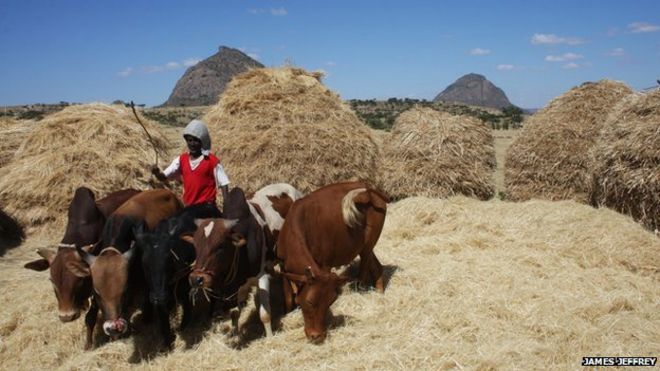
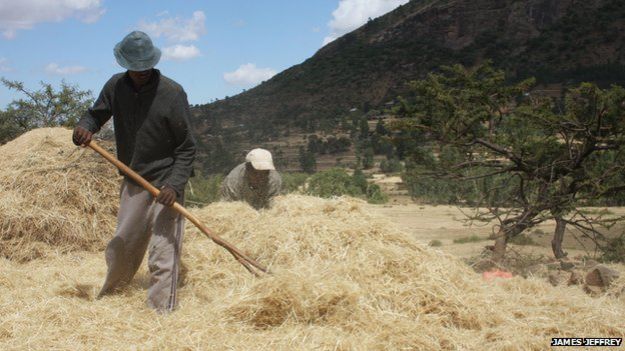
Under a bright blue sky, a farmer in a sleeveless red jumper is encouraging his five oxen to stamp on piles of dried grass, to help dislodge the seeds.
Nearby, other farm workers are using pitchforks to do the same job, throwing the grass into the air in an ancient process known as winnowing.
This is a harvest scene in rural Ethiopia, which at this time of the year is replicated across the length and breadth of the country.
The seed, or grain, in question is called teff.
Ethiopians have been growing and obsessing about teff for millennia, and it may be set to be become the new "super grain" of choice in Europe and North America, overtaking the likes of quinoa and spelt.
High in protein and calcium, and gluten-free, teff is already growing in popularity on the international stage.
Yet as teff is a staple foodstuff in Ethiopia, particularly when turned into a grey flatbread called injera, the country currently has a long-standing ban on exporting the grain, either in its raw form, or after it has been ground into flour.
Instead, entrepreneurial Ethiopian companies can at present only export injera and other cooked teff products, such as cakes and biscuits.
However, the hope is that if Ethiopia can sufficiently increase its teff harvest, then exports of the grain itself may be able to start in the not too distant future.
Air deliveries
"We started from scratch, and are now introducing our traditional food all over the world," says Hailu Tessema, founder of Mama Fresh, Ethiopia's first large-scale producer of injera.
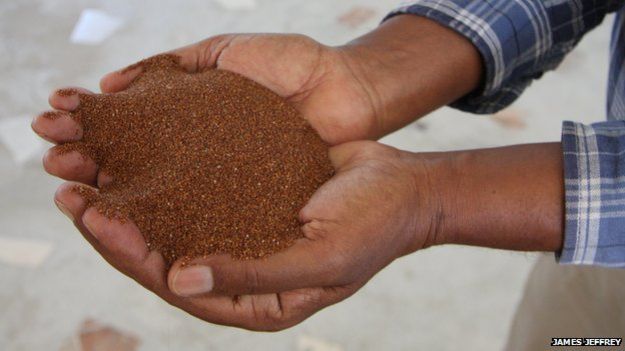
Grains of teff are as small as poppy seeds
Six days every week Mama Fresh uses Ethiopian Airlines to fly 3,000 injera flatbreads from Addis Ababa, the Ethiopian capital, to Washington DC in the US.
Injera is also flown to Sweden three times a week, Norway twice a week, and Germany three times a month.
"Demand is increasing by about 10% every month," says Mr Tessema, 60, who does not see the ban on exporting teff seeds as a problem.
"It's better to export a value-added product as that creates more jobs."
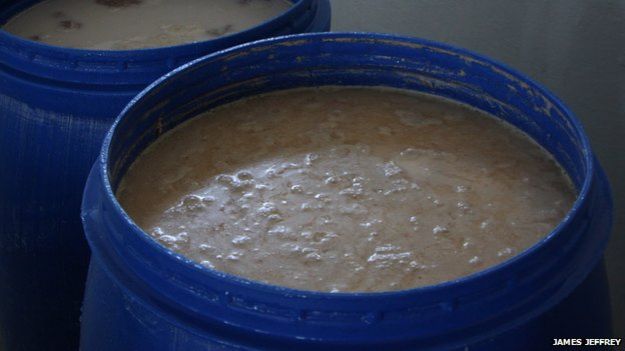
Teff flour is fermented before being turned into injera
Mama Fresh employs more than 100 people, and plans to take on another 50 this year. It also works with 300 farmers supplying teff.
Mr Tessema started the business in 2003 with 100,000 Ethiopian birr ($5,000; £3,225), operating out of a rickety shack.
The firm's annual revenue now stands at around 17m birr ($836,000; £566,000), and last year the business moved into a new factory.
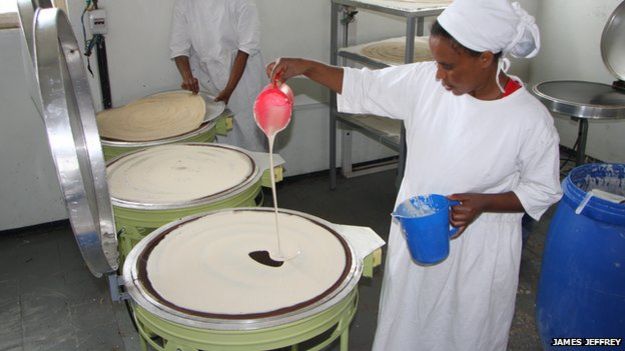
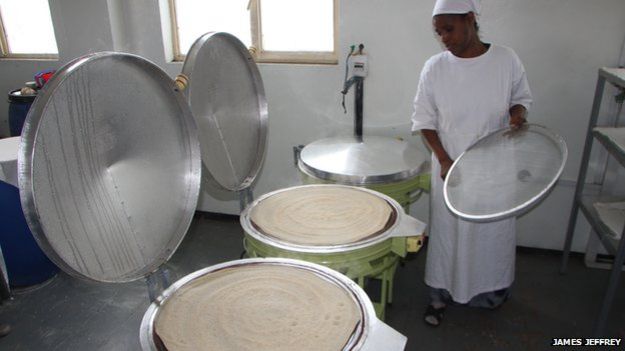
Injera is made by heating it like a pancakeAfter a few minutes the injera is ready
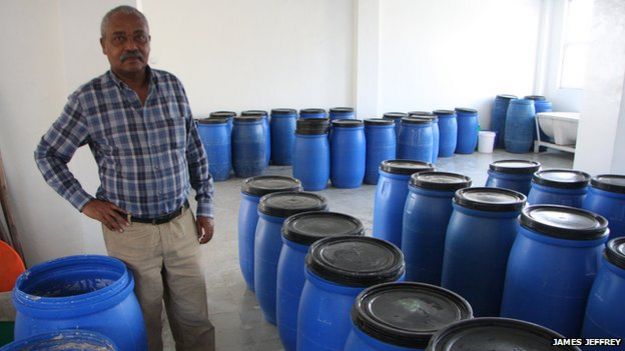
Inside the facility, blue barrels contain teff flour mixed with water, which is left to ferment for four days.
Afterwards, women pour small jug-sized amounts onto heated-clay cookers to sizzle and become injera, ready for packaging and speedy onward flights to eager overseas customers, mainly diaspora Ethiopians.
A tiny grain the size of a poppy seed, teff is ground into a flour which can also be made into loaves of European-style risen bread or pasta.
Hailu Tessema's company is exporting around the world
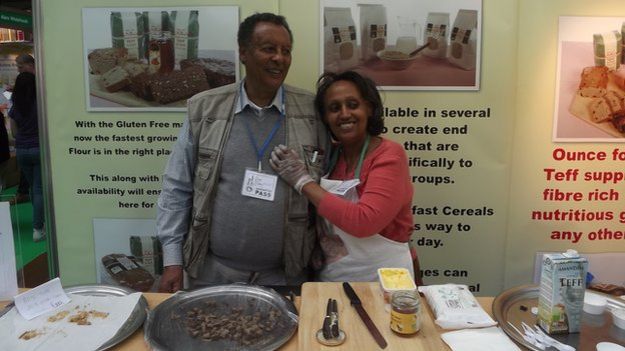
At London-based business, Tobia Teff, they use US-grown teff to make various breads and a porridge.
The company was founded by British-Ethiopian co-owner Sophie Sirak-Kebede, who originally opened an Ethiopian restaurant in the UK capital in 2003.
In 2008, she closed the restaurant to concentrate solely on selling teff.
"People are dreaming of teff nowadays, after thousands of years it has become the trendy thing over here," says the 58-year-old.
Tobia Teff's sales have increased by up to 40% during the last 14 months.
Even the UK's National Health Service has become a customer to cater for gluten-intolerant patients.
Achilles heel
Yet despite praise for teff's nutritional properties, its previously sheltered existence in Ethiopia comes with a drawback.
"Teff does not give much yield," says Zerihun Tadele, an Ethiopian researcher at the Institute of Plant Sciences at the University of Bern, Switzerland. "Very little research and investment has been done on the crop."
Sophie Sirak-Kebede is leading the promotion of teff in the UK
The average yield per hectare of teff in Ethiopia is 1.4 tonnes, which is less than half as much as the global average of 3.2 tonnes for modern varieties of wheat.
Mr Tadele hopes that through research and improved farming methods teff yields in Ethiopia can be raised to 5 tonnes a hectare.
This improvement will not come soon enough because recent teff harvests have failed to kept pace with Ethiopia's increasing population, driving prices beyond many Ethiopians' pockets, especially outside Addis Ababa.
Ms Sirak-Kebede says this situation creates a dilemma because "teff is Ethiopia's backbone". She adds: "A shortage of teff would be like asking an Ethiopian not to breathe".
Teff has been grown in Ethiopia for millennia
But at the same time, Ms Sirak-Kebede notes that the Ethiopian government should not squander a global opportunity that could benefit the more than six million farmers in the country that grow the seed, while also generating valuable foreign currencies.
The government's Agricultural Transformation Agency is now focused on increasing teff production to at least match domestic demand, after which exporting seeds and flour may become possible.
Teff facts
Teff is the seed of a grass native to Ethiopia known as lovegrass
It was one of the earliest cultivated plants
In Ethiopia teff is most often made into a pancake called injera, which is often used as a plate, with other foods placed on top
Gluten free
"The opportunity this presents to the country is significant and the benefit over the long term will far outweigh the risks," says Matthew Davis, a partner at US-based Renew Strategies, an early stage venture capital company investing in Mama Fresh.
"The government would likely proceed cautiously, only giving licences to select exporting companies."
No doubt the Ethiopian government has already looked nervously at the example of quinoa, which has become so popular on the global stage that many people in its native countries, such as Peru and Bolivia, can no longer afford to buy it.
If Ethiopia's teff export ban is ever lifted, Ms Sirak-Kebede says she wants to buy land in Ethiopia to farm the crop for her UK business.
"Being of Ethiopian origin I would prefer to get teff from Ethiopia," Ms Sirak-Kebede says.
"Who better than an Ethiopian farmer when it comes to teff? The quality is incomparable."
MINNEAPOLIS, MN, Mar. 16 /CSRwire/ - This month marks a watershed moment in nutrition and food security in Ethiopia: For the first time ever, local producers will begin fortifying wheat flour with the vitamins and minerals children need to develop and adults need to thrive. This achievement was made possible by a public-private partnership that stretches from mills, universities and government agencies in Ethiopia to the world’s largest multinational food companies, facilitated by a U.S.-based nonprofit.
Partners in Food Solutions (PFS) which, in partnership with TechnoServe and the U.S. Agency for International Development, connects employees at General Mills, Cargill, DSM and Bühler with high-potential food processors in five African countries, has worked with ASTCO, one of Ethiopia’s largest flour mills, to develop the technology and processes needed to fortify flour effectively and safely. Volunteer experts shared business and technical expertise with their Ethiopian counterparts through email, Skype, a proprietary web platform and occasional visits.
Other PFS volunteer experts have worked with more than 600 African food companies to improve food safety, packaging, processes, marketing and more to help them strengthen their businesses. In the end, this provides a sustainable route to affordable, nutritious, safe food for the local market and increases or sustains markets for the crops of smallholder farmers.
“The path to true food security in Africa isn’t simply more food aid,” said Jeff Dykstra, co-founder and CEO of Partners in Food Solutions. “The only sustainable way to end hunger is to strengthen the food supply chain. That’s why we’re focused on working with small and growing food processors.”
Chronic food insecurity and malnutrition are grave problems in Ethiopia, where two out of every five children suffer from stunting, which means a lack of critical nutrients has made them small for their age. Although the country’s economy is based largely on agriculture, millions of people require humanitarian assistance to survive. The availability of nutritious fortified wheat, a dietary staple in Ethiopia, is one step toward expanding access to nutritious food and reducing hunger.
In addition to ASTCO, about 150 wheat processors are receiving training or individualized assistance. The USAID helped fund the project, which PFS took on in partnership with the Africa-based organization TechnoServe and the African Alliance for Food Processing.
ASTCO and Partners in Food Solutions will celebrate the launch of its fortified flour at a ceremony in Addis Ababa on March 17, 2015.
About Partners in Food Solutions
Partners in Food Solutions (PFS) is a partnership that aggregates, mobilizes and remotely transfers employee expertise from world-class companies — General Mills, Cargill, Royal DSM and Bühler — to small and growing food companies in Africa. Its goals are to improve the ability of those companies to produce more high-quality, nutritious and safe food at affordable prices, and to increase market demand for crops from smallholder farmers. PFS collaborates closely with TechnoServe and the U.S. Agency for International Development (USAID).
About TechnoServe
TechnoServe is a nonprofit organization that works with enterprising people in the developing world to build competitive farms, businesses and industries. They develop business solutions to poverty by linking people to information, capital and markets. TechnoServe offers in-depth country knowledge and works in partnership with PFS and USAID to implement the AAIFP program.
Agency tasked with increasing productivity and efficiency in a sector that employs 85 percent of the country’s workforce
ADDIS ABABA, Ethiopia (Reuters) — Ethiopia’s ambition to become a manufacturing hub may hinge on Khalid Bomba’s ability to transform small-scale farming just as much as it relies on new railways and roads.
The 46-year-old one-time investment banker is chief executive officer of Ethiopia’s Agricultural Transformation Agency. His task is to increase production from a sector that employs 85 percent of the country’s workforce, most of them tilling plots of less than five acres.
“The cheap labour for industrial manufacturing is going to come from the rural areas,” he said.
“You are not going to have people coming off the farm if productivity levels don’t increase.”
Ethiopia boasts some of the highest economic growth in Africa, at eight percent or more a year. Much of it is fuelled by a huge state infrastructure program, which includes a new railway to Djibouti’s port, a city metro in the capital and vast hydro-electric dams, all aimed at attracting industrial investment.
However, agriculture still accounts for more than 42 percent of gross domestic product, high even in Africa.
The level is about 30 percent in next-door Kenya, yet Ethiopia still has to import basic foods to feed its population of 96 million.
The challenge for Bomba and his team at the agency, which was launched in 2011, has been to work out better planting, fertilizing and harvesting techniques while ensuring adoption by farmers, whose practices have sometimes barely changed since biblical times.
One of the first areas targeted by the agency was production of tef, a grain that is the main ingredient in Ethiopia’s national dish, njera, a kind of sour flat bread. Yields of 500 kilograms per acre were half or less of other grains in Ethiopia.
“The way that tef has been planted and grown has not changed for hundreds, if not thousands, of years,” Bomba said.
“The fact of the matter is that Ethiopia’s farmers had been planting too much seed.”
Farmers typically scatter 12 to 20 kg of seed per acre, but using just 1.5 to two kg, as well as planting in rows and using a particular seed variety, increased production by 50 to 70 percent, said Bomba, who was born in Ethiopia, studied in the United States and Britain, and spent 10 years with JPMorgan investment bank.
Only two farmers were initially willing to work with the agency, but adoption of the new practices has steadily increased. More than two million farmers adopted the techniques last year, although the rest of five million that were trained were still too wary to use them.
Rising production has driven down market prices of tef to the equivalent of $75 to $95 per 100 kg from $105 to $125. Higher yields also mean farmers can switch some of their land to other crops or even grow a second crop of pulses on the same tef land.
Bomba said tef exports, which are banned to avoid domestic shortages, could start on a small scale by the end of 2015 or 2016, although safeguards would be in place to protect local supplies.
Yields of wheat and corn have also improved. Wheat production has climbed almost eight percent a year since 2006 and reached 3.9 million tonnes in 2013-14, which met more than 85 percent of domestic needs.
The transformation agency is also studying the nation’s soil to improve fertilizer use.
Promoting better practices has relied on a government network of 60,000 “extension workers”, who help with training. This reflects the strong hand of state in other areas of the economy.
The agency is also spreading ideas by mobile phone.
Just as Ethiopia’s industrial drive has drawn heavily on Asia’s experience, the transformation agency was created after studying how nations such as Malaysia and South Korea grew.
Bomba led that study when he was working at the Bill & Melinda Gates Foundation, a philanthropic organization that still partly funds the agency.
He said roads and railways are the “shiny objects” that often capture the world’s attention, “but at the end of the day the backbone of this country remains the agricultural sector.”

 Print
 Email