By Robb M. Stewart
BHP Billiton is staying tightlipped on speculation it has decided to exit from a potash development in Ethiopia, even as the mining behemoth is expected to seek approval from its board later this year for the massive Jansen project in Canada.
Joel Jackson, an analyst at BMO Capital Markets, said that according to local sources BHP is believed to have decided to withdraw from the potash project in the African country. The company is reportedly closing down the camp at the site and is in the process of auctioning off equipment, Mr. Jackson said in a research report.
The Melbourne-based company said it isn’t its policy to comment on the specifics of its exploration programs.
“In general, the location of our exploration programs will change over time as opportunities emerge and as exploration programs are completed or transitioned to another business within BHP Billiton,” spokeswoman Kelly Quirke said."
'via Blog this'

A New Economic Paradigm
Sunday, June 17, 2012

Wednesday, June 13, 2012
Foreign Aid in the Horn of Africa Faces Austerity Ax -Ben Barber:
When very bright foreign aid experts on health, agriculture, logistics and education gathered at the 7th Aid and International Development Forum in Washington to talk about humanitarian aid in war, drought, earthquake and famine, they learned that we are in an age of austerity.
The global financial crisis has made foreign aid a target for budget cutters who often hear from voters "keep our aid money at home."
The global financial crisis has made foreign aid a target for budget cutters who often hear from voters "keep our aid money at home."
To get more bang for less buck, aid agencies such as the U.S. Agency for International Development (USAID) are cutting the number of costly Western aid workers sent overseas and instead hiring locals at a tenth the cost.
"Austerity will become an increasingly common part of our vocabulary as we talk about financing for development and humanitarian relief," said Patrick Fine, a senior U.S. aid official with the Millennium Challenge Corporation, in the keynote address to the June 6-7 forum.
"Iraq and Afghanistan that created billions of dollars worth of work for development and humanitarian aid organizations are winding down. I don't think we'll see anything like that again."
"Iraq and Afghanistan that created billions of dollars worth of work for development and humanitarian aid organizations are winding down. I don't think we'll see anything like that again."
Fine served as USAID mission director in Afghanistan in 2004 when billions were spent on schools, midwives, agriculture, roads and clinics. He warned that by 2015, one third of U.S. foreign aid -- which stood at $27 billion this year -- will be delivered through developing country governments and aid workers.
"As a result, expect the environment to become even more competitive," Fine told the aid workers at the forum. "If you are looking for areas where you can make a contribution, come up with new cost-effective and workable approaches for monitoring work and evaluating impact."
Fine's warning underscored that deep cuts in jobs are coming.
Foreign aid from the U.S. and other donors reached an incredible peak in the past few years of $130 billion a year. That money employs millions of people from Western and from developing nations to deliver relief, save lives and improve living standards for hundreds of millions. But now the humanitarian industry is at a crossroads.
The impending aid cut was one of three powerful facts that leaped out of many hours I spent sitting on panels June 6 and 7 in Washington, and from chatting with providers of bullet proof jeeps, medical kits, efficient stoves, water purification systems and emergency tents and generators:
- Despite knowing in 2010 that a famine was coming, the world wasted six months before shipping food to the Horn of Africa, letting perhaps 50,000 people die.
- For the first time in history, more people now die of chronic diseases -- caused by obesity, smoking, alcohol and sedentary occupations -- than from infections and trauma. Prevention now can save more lives than medical treatment.
- Although millions of dedicated aid workers live with the dust and danger of Sudan, Somalia and Afghanistan, the financial crisis is forcing aid mangers to cut back on costly Western aid teams and instead hire local people, train them and hope all goes well.
At one point it occurred to me that the three or four hundred experts and suppliers of tents and generators at the forum probably have saved hundreds of millions of lives over the years. No wonder so many young people today are taking courses in international development or interning and seeking jobs in the field -- they see greater satisfaction in helping others rather than amassing wealth.
Dr. Adam Koons, who has been delivering aid for decades for the U.S. Agency for International Development and other agencies, said aid workers feared being accused of "crying wolf" in 2010, when drought and famine was first predicted in Horn of Africa countries: Somalia, Ethiopia, Kenya, Djibouti and Uganda.
"We knew in 2010 and acted in 2011," said Koons, who now works with International Relief and Development (IRD), one the largest non-governmental organizations delivering American aid overseas.
"We were plagued by the CNN effect" he said, meaning that only when CNN broadcasts starving children does the U.S. government and other donors decide to send emergency aid.
"We were plagued by the CNN effect" he said, meaning that only when CNN broadcasts starving children does the U.S. government and other donors decide to send emergency aid.
"Lesson one is you can't wait for the media to get there because then it is too late," he said.
On a global health panel, I sat next to silver-haired Cecil Wilson, president of the American Medical Association and soon to serve as president of the World Medical Association, representing nine million doctors in more than 100 countries.
On a global health panel, I sat next to silver-haired Cecil Wilson, president of the American Medical Association and soon to serve as president of the World Medical Association, representing nine million doctors in more than 100 countries.
"Chronic illness is now the leading cause of death in rich and poor countries," said Dr. Wilson. Cancer, heart disease, diabetes, obesity, sedentary lifestyles and the aging population have replaced infection and trauma as leading causes of death, he said.
He predicted a sea change in medical investment, training and direction as the world medical profession focuses on prevention and promoting healthy lifestyles.
The aid industry includes great diversity, Fine said, such as "those whose primary motivation is to serve humanity and those focused on serving their shareholders; researchers and practitioners; young people moved by compassion and the desire to do good in the world and those who are driven by wanderlust and a desire for adventure."
"The evidence shows that critics who say money spent on development is money down a rat hole are dead wrong," Fine said. "We have seen momentous progress, both for nation states and individuals, in terms of more income, better health and increased opportunities."
Tuesday, June 5, 2012
Saturday, May 12, 2012
Facebook Billionaire Gives Up Citizenship to Escape Bad American Tax Policy - Forbes
+ Comment now
It is very sad that America’s tax system is so onerous that some rich people feel they have no choice but to give up U.S. citizenship in order to protect their family finances.
I’ve written about this issue before, particularly in the context of Obama’s class-warfare policies leading to an increase in the number of Americans “voting with their feet” for places with less punitive tax regimes.
We now have a very high-profile tax expatriate. One of the founders of Facebook is escaping for Singapore. Here are some relevant passages in a Bloomberg article.
- Eduardo Saverin, the billionaire co- founder of Facebook Inc. (FB), renounced his U.S. citizenship before an initial public offering that values the social network at as much as $96 billion, a move that may reduce his tax bill. …Saverin’s stake is about 4 percent,
according to the website Who Owns Facebook. At the high end of the IPO valuation, that would be worth about $3.84 billion. …Saverin, 30, joins a growing number of people giving up U.S. citizenship, a move that can trim their tax liabilities in that country. The Brazilian-born resident of Singapore is one of several people who helped Mark Zuckerberg start Facebook in a Harvard University dorm and stand to reap billions of dollars after the world’s largest social network holds its IPO. “Eduardo recently found it more practical to become a resident of Singapore since he plans to live there for an indefinite period of time,” said Tom Goodman, a spokesman for Saverin, in an e-mailed statement. …Singapore doesn’t have a capital gains tax. It does tax income earned in that nation, as well as “certain foreign- sourced income,” according to a government website on tax policies there. …Renouncing your citizenship well in advance of an IPO is “a very smart idea,” from a tax standpoint, said Avi-Yonah. “Once it’s public you can’t fool around with the value.” …Renouncing citizenship is an option chosen by increasing numbers of Americans. A record 1,780 gave up their U.S. passports last year compared with 235 in 2008, according to government records. …“It’s a loss for the U.S. to have many well-educated people who actually have a great deal of affection for America make that choice,” said Richard Weisman, an attorney at Baker & McKenzie in Hong Kong. “The tax cost, complexity and the traps for the unwary are among the considerations.”

What makes this story amusing, from a personal perspective, is that Saverin’s expatriation takes place just a couple of days after my wayward friend Bruce Bartlett wrote a piece for the New York Times, in which he said that people like me are exaggerating the impact of taxes on migration.
Here are some key excerpts from Bruce’s column.
In recent years, the number of Americans renouncing their citizenship has increased. …the number of Americans renouncing their citizenship rose to 1,781 in 2011 from 231 in 2008. This led William McGurn of The Wall Street Journal to warn that the tax code is turning American citizens living abroad into “economic lepers.” The sharply rising numbers of Americans renouncing their citizenship “are canaries in the coal mine,” he wrote. The economist Dan Mitchell of the libertarian Cato Institute was more explicit in a 2010 column in Forbes, “Rich Americans Voting With Their Feet to Escape Obama Tax Oppression.” …the sharp rise in Americans renouncing their citizenship since 2008 is less pronounced than it appears if one looks at the full range of data available since 1997, when it first was collected. As one can see in the chart, the highest number of Americans renouncing their citizenship came in 1997. …The reality is that taxes are just one factor among many that determine where people choose to live. Factors including climate, proximity to those in similar businesses and the availability of amenities like the arts and cuisine play a much larger role. That’s why places like New York and California are still magnets for the wealthy despite high taxes. And although a few Americans may renounce their citizenship to avoid American taxes, it is obvious that many, many more people continually seek American residency and citizenship.
I actually agree with Bruce. Taxes are just one factor when people make decisions on where to live, work, save, and invest.
But I also think Bruce is drinking too much of the Kool-Aid being served by his new friends on the left. There is a wealth of data on successful people leaving jurisdictions such as California and New York that have confiscatory tax systems.
And there’s also lots of evidence of taxpayers escaping countries controlled bypoliticians who get too greedy. Mr. Saverin is just the latest example. And I suspect, based on the overseas Americans I meet, that there are several people who quietly go “off the grid” for every person who officially expatriates.
The statists say these people are “tax traitors” and “economic Benedict Arnolds,” but those views are based on a quasi-totalitarian ideology that assumes government has some sort of permanent claim on people’s economic output.
If people are leaving America because our tax law is onerous, that’s a signal we should reform the tax code. Attacking those who expatriate is the fiscal version of blaming the victim.
Monday, May 7, 2012
Thursday, April 26, 2012
Does aid to Africa from Brics countries differ from traditional aid? | Jonathan Glennie | Global development | guardian.co.uk
In the new scramble for Africa, emerging economies insist their aid motives are not those of the west – but African nations should still beware


Chinese labourers work on a project in Bata, Equatorial Guinea. Photograph: Abdelhak Senna/AFP/Getty Images
It is not original to remark that there is a modern-day scramble for Africataking place. Economic growth averaging around 5% on the continent for the past decade is certainly good news compared with two decades of increasing poverty. But on the other side of the coin are the reasons for that growth: the large-scale export of commodities with no clear industrial or institutional benefits. "Jobless growth", the source of the uprisings in north Africa, is the norm in Africa, and although manufacturing exports quadrupled to over $100bn in the last decade, manufacturing is actually declining as a proportion of GDP from a fairly stable 17% between 1965 and 1990 to 13% today.
Clearly African countries need to think hard about their development strategies and how best to take advantage of the changing global context. Is the ever-growing interest in Africa's land and resources its route out of poverty, or are we seeing dependency theory in action, with resources being extracted with little resembling sustainable development left behind? A recent article on the impact of oil wealth in Chad bears out this complex picture.
Although trade and investment will ultimately be far more important, a changing African aidscape will also play a part in the continent's future. What is the role of aid in this context? What are its motives? And are some aid partners better than others?
The US secretary of state, Hillary Clinton, certainly seems to think so, urging poor countries at an aid conference in Busan, South Korea, to "be wary of donors who are more interested in extracting your resources than in building your capacity". It is hard to imagine a more absurd statement from a US official, given the country's leading role in previous scrambles for Africa – not to mention its weak record (with other donors) of "building capacity" over more than 50 years of aid-giving. From the cold war to aid conditionality supporting its own interests, to the pouring of money into the Horn of Africa after the 9/11 attacks, the US pretty much wrote the book on how to use aid to ensure strategic interests. Clinton should remember John Kennedy's assertion in 1962: "Aid is a method by which the United States maintains a position of influence and control around the world … I put it right at the top of the essential programmes in protecting the security of the free world."
While Clinton tries to deny reality, the Brics countries are engaged in their own propaganda, claiming their "south-south co-operation", which often explicitly links aid with trade, places a new emphasis on mutual benefit, solidarity and self-reliance. Are they right? Many African leaders appear to think so. According to Ethiopia's prime minister, Meles Zenawi: "China, its amazing re-emergence and its commitment for a win-win partnership with Africa, is one of the reasons for the beginning of the African renaissance."
Brazil, another Brics country, is at the forefront of the south-south rhetoric, insisting that far from eschewing capacity building, as Clinton claims, its co-operation is entirely focused on it. But Brazil's trade with Africa, which grew five-fold between 2002 and 2009, follows distinctly colonial patterns, as Padraig Carmody says in his book The New Scramble for Africa – Brazil exports manufactured goods and food to Africa, while Africa provides Brazil with oil and coal.
So where does the truth lie?
First, the OECD's development assistance committee (DAC) and Brics categories are not necessarily that useful – neither is a homogenous group. Brazilian aid has little in common with Chinese aid: it is relatively miniscule and focuses on technology and capacity, while China's huge aid budget funds infrastructure. Russia is totally different again, and South Africa is still close to irrelevant in aid terms, with a budget of under $100m. Nor does Norwegian aid resemble US aid in any significant way, despite signing up to the same DAC ways of working.
In some important ways it can be more useful to separate western (US and Europe) style aid from eastern (Korean, Japanese and Chinese). The latter are generally less interested in policy conditionality and more focused on infrastructure, while the former have a strong tendency to conditionalise aid, while focusing, at least in the MDG era, on social sectors. Of western donors, only Germany spent more than 15% of its aid on infrastructure in 2009-10, while South Korea and Japan both spent over 40%, and China 60%.
The appearance of China, India and Brazil on the scene, coupled with the dire problems in western economies, has transformed the political landscape. These three countries, along with South Africa, are steeped in an anti-imperialist tradition and ideology that promotes self-reliance and partnership over the faux charity of colonial powers, which give with one hand and crush with the other. They also have a greater familiarity with the political and economic conditions of developing countries, probably an advantage both commercially and in terms of promoting development.
Their growing prominence is a welcome balance to the deeply ingrained arrogance of western donors. However, this difference can easily be exaggerated. India and China are clearly using aid money to achieve political interests and economic advantage, in similar ways to traditional donors. China insists its partners ditch recognition of Taiwan, and its spending in Africa is heavily focused on resource-rich countries such as Sudan. India uses credit lines to promote its exports and focuses on the energy sector, as the world's fifth-largest energy consumer. Even South Africa, once the cause celebre of anti-imperialism, has become something of an imperial presence in many less powerful countries in Africa. According to Unctad, over 50% of foreign investment in Botswana, the Democratic Republic of the Congo, Lesotho, Malawi and Swaziland comes from South Africa. As it grows in power, it is more than likely that its new aid programme will come to the service of such strategic investments.
Is foreign investment vital for growth, or a tool for resource extraction? Is aid solidarity or bribery? All donors, DAC or Brics, old or new, have mixed motives – part goodwill, part strategic interest. African countries would be foolish to believe the rhetoric of traditional or emerging partners, and should base their aid management strategies on a realistic assessment of the incentives and intentions of all entities that arrive at their airports bearing giftshttp://static.guim.co.uk/sys-images/Environment/Pix/columnists/2012/3/23/1332509341435/MDG--BRICS-leaders-meetin-002.jpg
Wednesday, April 11, 2012
US AIDS Cut Program MSF Alarmed - Africa | English


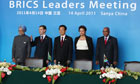

Photo: AP
Blood is tested at the AIDS Care Training and Support Initiative (ACTS) at White River Junction, South Africa. The center is partly funded by the President's Emergency Plan for AIDS Relief (PEPFAR), December 2008 photo
Medical aid organization Doctors Without Borders is concerned that proposed budget cuts to a U.S. program for HIV treatment around the world threatens the progress being made against the pandemic in Africa.
On World AIDS Day in December, U.S. President Barack Obama announced that the United States would aim to treat six million people infected with HIV around the world by the end of 2013 - two million more than the previous target.
The organization responsible for the outreach will be the President's Emergency Plan for AIDS Relief, better known by its acronym PEPFAR.
But while Mr. Obama has pledged to expand PEPFAR to include more people, his budget proposal for the fiscal year 2013 cuts more than a half-billion dollars from the program, about 13 percent of its current funding.
Doctors Without Borders, known by its French acronym MSF, has raised the alarm over the proposed cut, saying it will undermine the president's own goals.
Jennifer Cohn, the East Africa policy advisor for the MSF Access Campaign, said she is concerned that countries that receive PEPFAR support may begin scaling back their own treatment programs in anticipation of the cuts.
“In terms of the budget shortfall, I think many problematic things might occur as a result of that, including decreases in treatment, decreases in other sorts of support, and then, sort of a chilling effect on country guidelines themselves,” said Cohn.
Budget figures outlined by MSF show some major reductions in Africa, including a nearly 50 percent cut in funding for Kenya and 82 percent for Ethiopia.
In a post on the official State Department blog in February, U.S. Global AIDS Coordinator Eric Goosby wrote that the administration is “freeing up resources by reducing programs in countries with a lower HIV prevalence,” specifically mentioning Ethiopia. He also said the program in Kenya had “matured” and that it was adjusting the country's funding to reflect a new focus on local implementation.
On World AIDS Day in December, U.S. President Barack Obama announced that the United States would aim to treat six million people infected with HIV around the world by the end of 2013 - two million more than the previous target.
The organization responsible for the outreach will be the President's Emergency Plan for AIDS Relief, better known by its acronym PEPFAR.
But while Mr. Obama has pledged to expand PEPFAR to include more people, his budget proposal for the fiscal year 2013 cuts more than a half-billion dollars from the program, about 13 percent of its current funding.
Doctors Without Borders, known by its French acronym MSF, has raised the alarm over the proposed cut, saying it will undermine the president's own goals.
Jennifer Cohn, the East Africa policy advisor for the MSF Access Campaign, said she is concerned that countries that receive PEPFAR support may begin scaling back their own treatment programs in anticipation of the cuts.
“In terms of the budget shortfall, I think many problematic things might occur as a result of that, including decreases in treatment, decreases in other sorts of support, and then, sort of a chilling effect on country guidelines themselves,” said Cohn.
Budget figures outlined by MSF show some major reductions in Africa, including a nearly 50 percent cut in funding for Kenya and 82 percent for Ethiopia.
In a post on the official State Department blog in February, U.S. Global AIDS Coordinator Eric Goosby wrote that the administration is “freeing up resources by reducing programs in countries with a lower HIV prevalence,” specifically mentioning Ethiopia. He also said the program in Kenya had “matured” and that it was adjusting the country's funding to reflect a new focus on local implementation.
Proposed cuts not final
PEPFAR senior advisor Tom Walsh said all the budget figures being discussed are preliminary and that some of the country figures are certain to change.
Still, he emphasized that PEPFAR has made dramatic gains in efficiency, and that the budget requested for 2013 is the amount needed.
“Over the years, we've gotten the cost of treating an individual person per year with antiretroviral therapy down from about $1,100 in 2004 to $335 in 2011," said Walsh.. "That kind of dramatic gain in efficiency, in reaching more people with the resources available, is what Congress likes to see and we think we're going to make continued progress on that front.”
The president's budget proposal needs the approval of the U.S. Congress. Walsh said PEPFAR has always received strong bipartisan support.
MSF is not only concerned about the budget numbers, but also with some of the program's accounting methods.
Cohn said the way PEPFAR counts the number of people receiving treatment can be misleading.
“What we're finding is actually that whereas PEPFAR is not necessarily directly supporting people on treatment in certain countries, they're actually counting those people toward the 6 million people they promise to put on treatment by 2013, so we find that concerning and somewhat disingenuous,” said Cohn.
Cohn's concerns are highlighted in a U.S. report from earlier this year on PEPFAR's programming in Malawi.
In the document, PEPFAR outlines the support it provides in the country, such as funding staff for visits to treatment sites, training service partners and developing an electronic data system. Nowhere does it say the U.S. provides antiretroviral medication (ARVs) for patients.
But, in the “Recommendations” section of the document, the authors suggest that all HIV-infected adults receiving treatment in Malawi's national program should be reported as “directly supported” by the U.S. government.
Tom Walsh for PEPFAR could not confirm that this accounting practice is common, and said the methods vary based on the arrangements in each individual country.
He said the U.S. supports a variety of services, and treating HIV is about more than just providing drugs.
“ARVs are an important part of treatment, but also important is the infrastructure to deliver the drugs, support for the clinics, training for the health providers who do the work," said Walsh. "In every country there's a different combination of resources that it takes to deliver treatment.”
Still, he emphasized that PEPFAR has made dramatic gains in efficiency, and that the budget requested for 2013 is the amount needed.
“Over the years, we've gotten the cost of treating an individual person per year with antiretroviral therapy down from about $1,100 in 2004 to $335 in 2011," said Walsh.. "That kind of dramatic gain in efficiency, in reaching more people with the resources available, is what Congress likes to see and we think we're going to make continued progress on that front.”
The president's budget proposal needs the approval of the U.S. Congress. Walsh said PEPFAR has always received strong bipartisan support.
MSF is not only concerned about the budget numbers, but also with some of the program's accounting methods.
Cohn said the way PEPFAR counts the number of people receiving treatment can be misleading.
“What we're finding is actually that whereas PEPFAR is not necessarily directly supporting people on treatment in certain countries, they're actually counting those people toward the 6 million people they promise to put on treatment by 2013, so we find that concerning and somewhat disingenuous,” said Cohn.
Cohn's concerns are highlighted in a U.S. report from earlier this year on PEPFAR's programming in Malawi.
In the document, PEPFAR outlines the support it provides in the country, such as funding staff for visits to treatment sites, training service partners and developing an electronic data system. Nowhere does it say the U.S. provides antiretroviral medication (ARVs) for patients.
But, in the “Recommendations” section of the document, the authors suggest that all HIV-infected adults receiving treatment in Malawi's national program should be reported as “directly supported” by the U.S. government.
Tom Walsh for PEPFAR could not confirm that this accounting practice is common, and said the methods vary based on the arrangements in each individual country.
He said the U.S. supports a variety of services, and treating HIV is about more than just providing drugs.
“ARVs are an important part of treatment, but also important is the infrastructure to deliver the drugs, support for the clinics, training for the health providers who do the work," said Walsh. "In every country there's a different combination of resources that it takes to deliver treatment.”
Partnering against HIV/AIDS
The United States is increasing its reliance on partners in treatment programs, one of the biggest being the Global Fund to Fight AIDS, Tuberculosis and Malaria.
Walsh points out that responsibilities for HIV programs around the world are divided up between partner organizations. So, PEPFAR may pay for training and infrastructure, while the Global Fund or the host government buys the medication.
Despite scaling back PEPFAR, President Obama's 2013 budget request includes an increase of $350 million for the Global Fund.
But that increase does not make up for PEPFAR's cuts. If the budget is approved as is, the net decrease for AIDS funding would be about $213 million.
The United States is increasing its reliance on partners in treatment programs, one of the biggest being the Global Fund to Fight AIDS, Tuberculosis and Malaria.
Walsh points out that responsibilities for HIV programs around the world are divided up between partner organizations. So, PEPFAR may pay for training and infrastructure, while the Global Fund or the host government buys the medication.
Despite scaling back PEPFAR, President Obama's 2013 budget request includes an increase of $350 million for the Global Fund.
But that increase does not make up for PEPFAR's cuts. If the budget is approved as is, the net decrease for AIDS funding would be about $213 million.
Subscribe to:
Posts (Atom)